
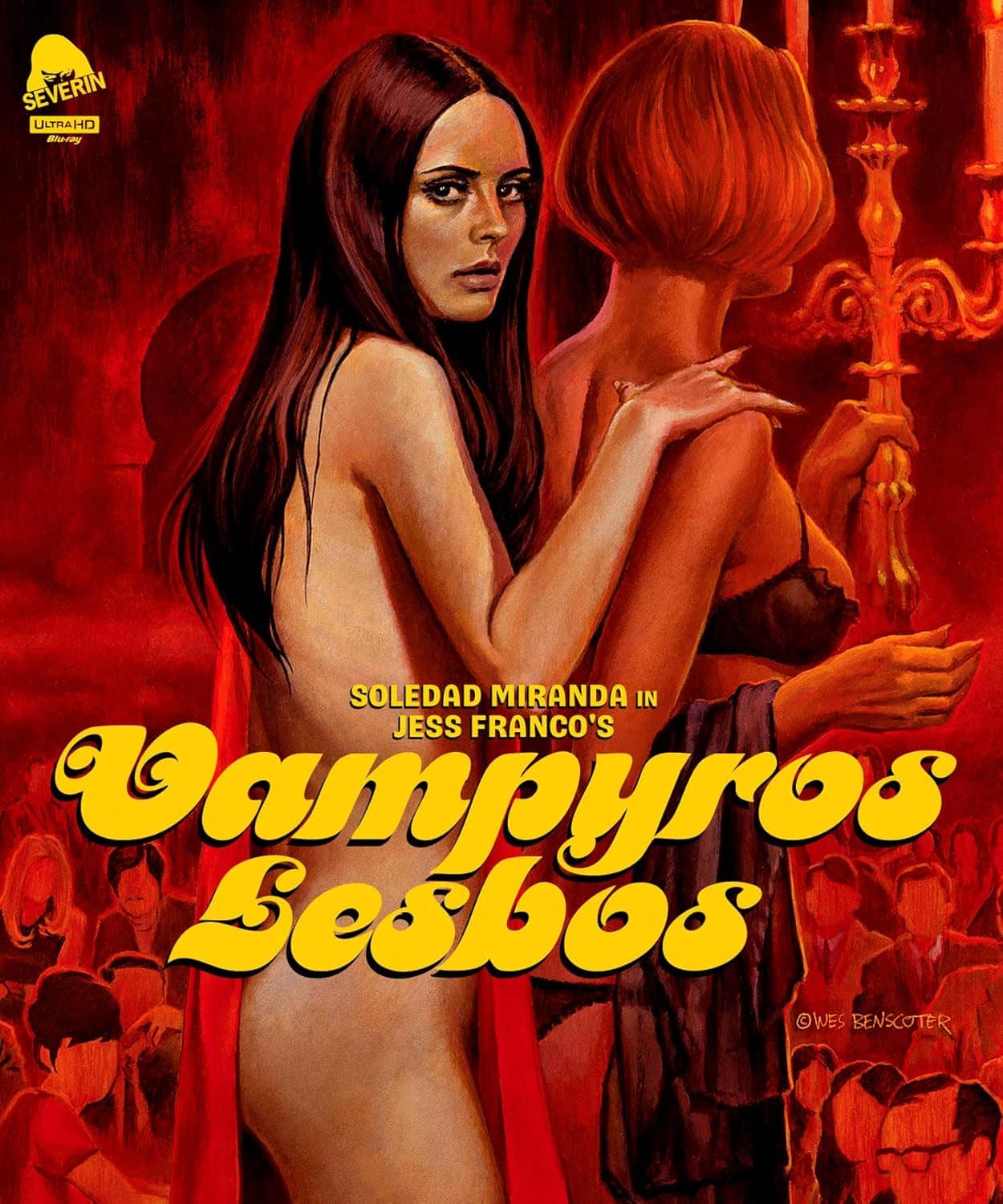
 Having recently completed Count Dracula with Christopher Lee, a troubled production that attempted (and failed) to deliver a scrupulously faithful adaptation of Bram Stoker’s novel, maverick Spanish filmmaker Jess Franco opted to turn the narrative on its head with Vampyros Lesbos, cheekily tweaking the traditional iconography of vampire cinema along the way. This is also one of Franco’s most explicitly surreal films, systematically blurring the line between dream and reality from start to finish.
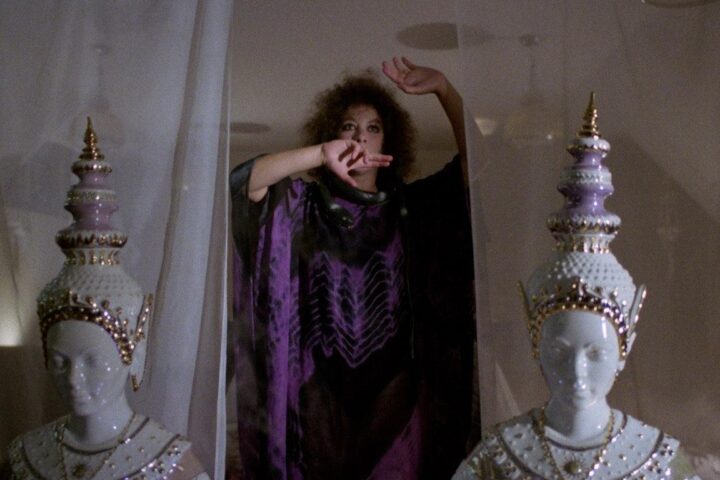
Vampyros Lesbos opens with an event that features in many of Franco’s works: an erotically charged nightclub act. After writhing before an ornate mirror, a raven-haired beauty (Soledad Miranda) slowly strips and then dresses a mannequin-like nude woman in her clothes before lowering her to the ground and pressing her mouth to her throat—the act of vampirism presented as performance piece. Already we have our first thumb inserted in the eye of convention: a character revealed to be an actual vampire proudly observing herself in the mirror. When we meet her again, she will be happily sunning herself al fresco.
The scene cuts to the office of psychiatrist Dr. Steiner (Paul Müller). On the couch is Linda Westinghouse (Ewa Strömberg), who claims that she had seen the nightclub performer in her dreams long before encountering her in person. Notably ambivalent, these dreams both attract and repel Linda. Steiner diagnoses sexual frustration and suggests that Linda find a more satisfactory lover than Omar (Andrea Montchal). This tidily sets up the entire rest of the film, wherein Linda gets a taste of truly liberating erotic fulfilment, albeit with another woman, but finally rejects this freedom for the rather confining comforts of hetero domesticity, which is explicitly presented as hard reality compared to the “bad dream” of sapphic satisfaction.
Linda journeys to meet Countess Nadine Carody (Miranda) and discuss her inheriting Dracula’s entire estate. Here we have a decidedly distaff riff on Stoker’s novel, with the two male characters changed into women. The overt link to the source material reminds us just how profound Franco’s alterations are. This is also the case when we meet the film’s Renfield equivalent, Agra (Heidrun Kassin), who’s been rendered certifiable by the countess’s rejection.
Franco also conflates Stoker’s main authority figures in the person of Dr. Alwin Seward (Dennis Price). Not only is the doctor flippant and dismissive in his treatment of his patients, he harbors the secret desire to become a vampire himself. He’s gone over to the dark side, and he’s ultimately punished for his hubris. The other major male presence in the film is Mehmet, played by Franco himself in one of his many cameos. Seemingly a lowly porter, Mehmet has a second life in the hotel basement, where he tortures women into confessing their love for him—a pathetic attempt to exert control over women that also ends up costing him his life.
In a later scene that recalls Linda’s session with Steiner, the countess relates to her familiar, Morpho (José Martínez Blanco), her history with Dracula. Centuries ago in her native Hungary, the count saved her from an act of wartime rape that left her a man-hater, conferred the gift of immortal vampiric existence on her, and then made her his heir. The only halfway decent male character in the film is, by most accounts, an inhuman monster.
Franco and DP Manuel Merino concoct a number of aesthetic strategies that would continue to dominate the majority of Franco’s output (especially the more experimental outings). For one, the extensive use of the zoom lens—often in combination with a bizarrely deployed rack focus—takes on an investigatory, almost phenomenological function. Blurring the lines between the real and the apparent, the camera frequently captures events in reflective surfaces like windows and mirrors, often both zooming and racking focus to achieve some truly disorienting effects.
Vampyros Lesbos ends as tragedy, with Linda being reclaimed by the forces of masculine authority as represented by Omar and Steiner, though they’ve arrived on the scene too late to save the day. Their failure is another cheeky inversion of Stoker’s novel, as well as the majority of its adaptations, particularly the string of Hammer Dracula films where Peter Cushing rushes in to dispatch Christopher Lee. In a deft visual metaphor, the colorful kite sent aloft in the first scene and seen throughout the film, where it seems to stand for the possibility of transcendence offered by Linda’s encounter with the countess, comes crashing to earth in the end.
Image/Sound
Severin offers Vampyros Lesbos in both 2160p UHD and 1080p HD versions with 4K restorations sourced from the original camera negative. The HDR Dolby Vision presentation of the former looks truly revelatory: colors are incredibly vivid (especially those almost ubiquitous reds); black levels are profound and entirely uncrushed; and the fine details in the film’s exquisite costumes and décor are more noticeable than ever. The German-language Master Audio two-channel mono mix sounds exquisite, really putting front and center the absolutely fabulous psych rock score from composers Manfred Hübler and Sigi Schwab.
Extras
On the first of two nicely complementary commentary tracks, Daughters of Darkness author Kat Ellinger offers a profound thematic reading of Vampyros Lesbos, touching on topics like gothic literature, the “feminine abject,” Eurocult sensibilities, and the lesbian vampire cycle of the early ’70s. The other track, featuring film professor Aaron AuBuchon and Oscarbate Film Collective’s John Dickson and Will Morris, provides a deep dive into the life and career of Jesus Franco, including this film’s status as a common gateway to the filmmaker’s idiosyncratic oeuvre and a detailed analysis of Franco’s stylistic and thematic obsessions.
We also get a number of video extras both old and new. “Interlude in Lesbos” finds Franco talking about his German producers, why the film is set in Istanbul, his handling of the vampire material, his working relationship with Soledad Miranda, and his fondness for depicting the erotic relationship between two women. “Sublime Soledad” covers the tragically short-lived career of Miranda, with lots of biographical information about her early years, and plenty of priceless film and television clips (presented by historian Amy Brown). Elsewhere, “Jess is Yoda” is a playful interview snippet about Franco’s favorite makeup effects artist.
Stephen Thrower, author of a terrific two-volume study of Franco, provides two of the most substantial new supplements. In “Fever Dracula,” he discusses how the film relates to Count Dracula, where it stands among Franco’s collaborations with producer Artur Brauner, and how the film began a new and experimental trend in later Franco films. In another feature, Thrower tours the locations for several films shot in Lisbon and Paris (though obviously Vampyros Lesbos isn’t among them), and filmmaker Sean Baker discusses how his Oscar-winning Anora nodded to Miranda and Franco by way of the red scarf Mikey Madison wears in the film.
Overall
A woozy fever dream of a film, Jess Franco’s distaff Dracula riff Vampyros Lesbos cheekily upends the conventions of vampire cinema.
Since 2001, we've brought you uncompromising, candid takes on the world of film, music, television, video games, theater, and more. Independently owned and operated publications like Slant have been hit hard in recent years, but we’re committed to keeping our content free and accessible—meaning no paywalls or fees.
If you like what we do, please consider subscribing to our Patreon or making a donation.

👍🏻 Drooling!