In the opening paragraphs of his 2004 novel After Dark, Murakami Haruki likens urban Tokyo to a living, breathing organism. “To the rhythm of its pulsing, all parts of the body flicker and flare up and squirm.” The book, which spans one night, is narrated in the first-person plural by an unnamed, unseen, nigh-omniscient figure, and each of its chapters opens with a header denoting times between 11:56 p.m. and 6:52 a.m. In this brief window, several seemingly disparate characters become entangled, drawn together by some mysterious combination of circumstance and fate. This being Murakami, there are cats.
Those familiar with Ghost Trick: Phantom Detective—originally released on the Nintendo DS in 2010, now remastered for modern hardware—will detect some similarities, many of which are likely intentional. The game, as with the rest of designer-writer-director Takumi Shu’s work, is an eclectic amalgam of literary and cinematic influences, rewritten and rearranged to necessitate interactivity. For all that Ghost Trick and After Dark share in common, there’s a key distinction between them: After Dark’s narrator cannot interfere with any events therein.
Ghost Trick, meanwhile, is built for interference. Its story has already been written, and the fates of its characters are already decided. Something will happen in this city tonight, and you, a ghost, must author something new. Takumi’s metropolis isn’t an organism, self-sufficient and autonomous. It’s a Rube Goldberg machine, an assemblage of mechanically precise interlocking parts, decisive in its purpose but prone to tinkering and alteration.
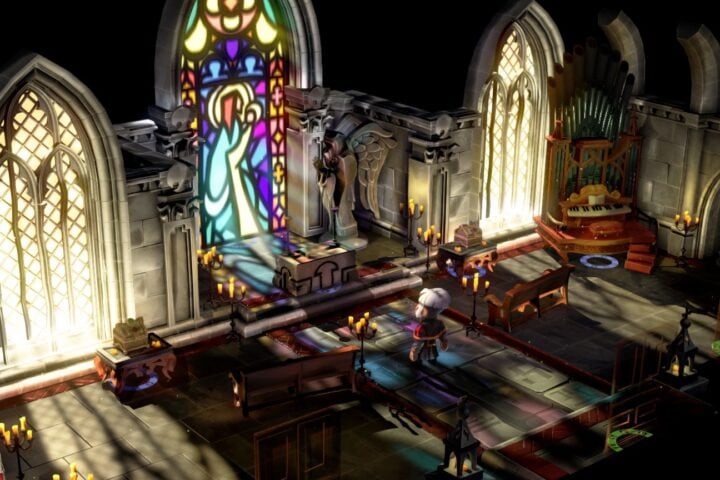
The game is easy to play and difficult to describe. It takes place entirely on a 2D plane, and its environments are meticulously detailed cutaway renderings of cityscapes and building interiors. Players take control of Sissel, a spectral, recently deceased amnesiac who has until dawn to solve the mystery of his own murder. Sissel moves around by “possessing” various objects, represented visually by a glowing blue orb snapping to different onscreen targets. Once possessed, certain objects can be manipulated with the titular “ghost tricks,” which change depending on the object in question. (Wheels can be spun, doors can be opened, and so forth.)
In a typical scenario, multiple characters congregate in a shared space, and a sequence of escalating conflicts—between the characters, and between the characters and their environment—results in one of them dying. Sissel, who can rewind time to minutes before a person’s death, attempts to rectify this, manipulating objects in ways that take into account both their physical makeup and how characters will react to them. Once these actions are undertaken in a certain order—each flowing logically into the next, warping the original sequence beat by beat—a new outcome emerges. Put simply, stories and puzzles are the same thing in Ghost Trick. Here, narrative generates gameplay, and gameplay writes the narrative in real time.
Since their inception, video games have circled the question of how to most effectively tell stories within an interactive framework, and few pull it off as seamlessly as Ghost Trick does. It looks at other narrative-driven games—particularly visual novels and point-and-click adventures, its two most apparent forebears—and (politely) cries foul. Why shouldn’t one’s understanding of a text-based story directly inform how one interacts with it, and why shouldn’t problem-solving and narrative progression unfold in tandem? Ghost Trick is the reason I started asking these questions. The game’s design is compelling enough that, for the past decade and change, I’ve been unable to stop myself from noticing its absence elsewhere.
Of course, this design necessarily hinges on both halves being equally compelling: If the plot were uninteresting, the gameplay would be meaningless, and vice versa. Luckily, Takumi is brilliant, and Ghost Trick is a culmination and accentuation of all the mystery writing and puzzle crafting skills he’d already honed in the excellent Ace Attorney series, the main difference being that Ghost Trick consists of one long story instead of several shorter ones.
It needs to, because everything in the game is connected to everything else. Every plot development, every seemingly minor player action, is a flap of the proverbial butterfly’s wings. Questions compound, the game continually upends itself, and by the time all of its circuitous setups have converged into an explosive payoff, you’ll feel like you’ve read a novel.
You’ll also feel like you’ve helped write one. Ghost Trick is a story about stories, about how the invisible machinations of a guiding hand can create something whole and beautiful. It could only ever be a video game. At the risk of embellishment, it might be one of the video games. That it’s found a home on modern hardware is encouraging, and that Capcom saw fit to leave it more or less untouched is a small miracle. This is Ghost Trick as it always was: pristine, unassuming, and inimitable. And this remaster will make you glad that it’s been resurrected.
This game was reviewed with code provided by fortyseven communications on June 30.
Since 2001, we've brought you uncompromising, candid takes on the world of film, music, television, video games, theater, and more. Independently owned and operated publications like Slant have been hit hard in recent years, but we’re committed to keeping our content free and accessible—meaning no paywalls or fees.
If you like what we do, please consider subscribing to our Patreon or making a donation.