
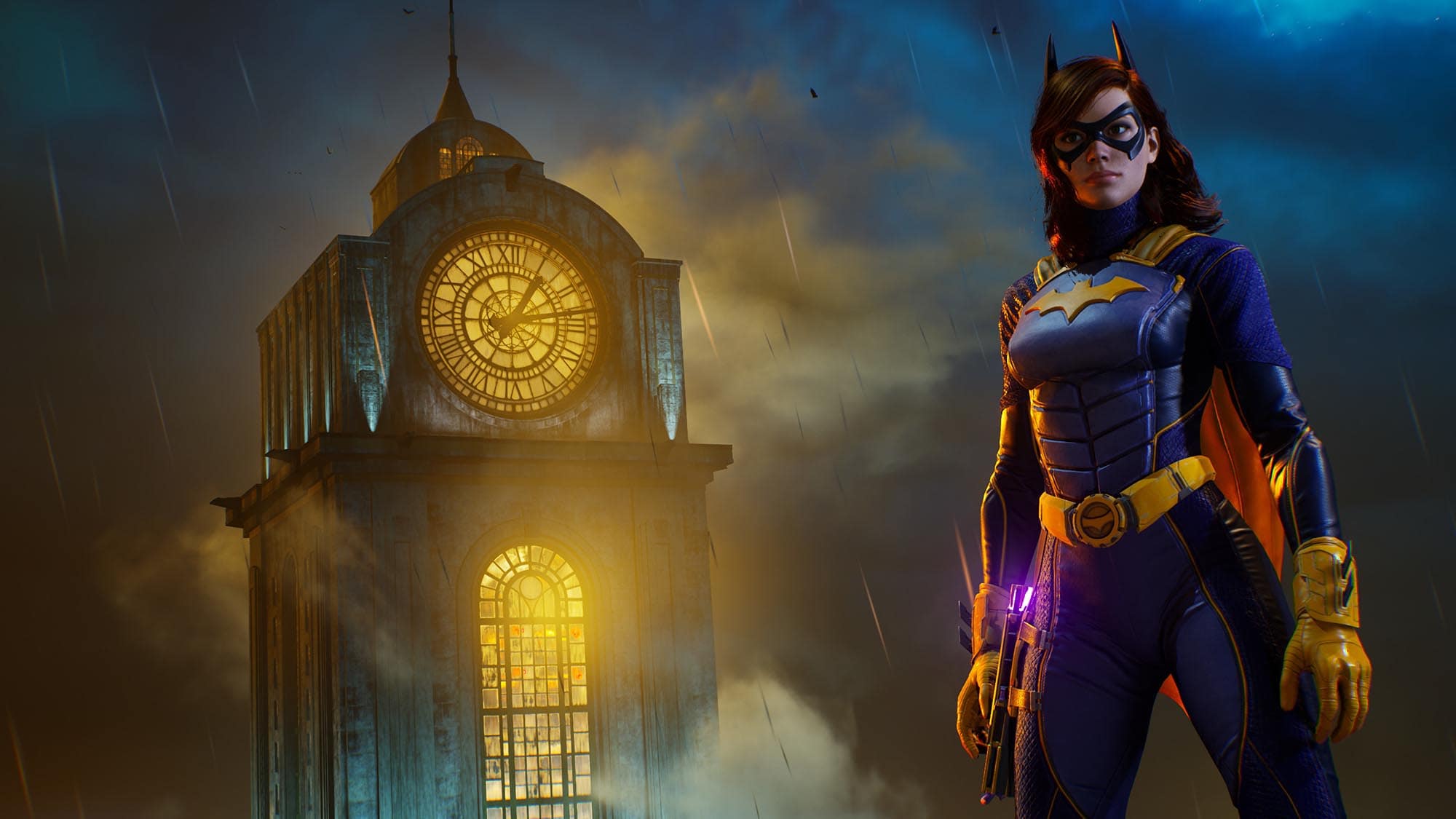
For a moment, it looks like Batman might just have one more trick up his sleeve. But no, in a suicidal last resort, the Caped Crusader blows himself, Ra’s al Ghul, and the Batcave up, and Gotham Knights follows his Bat Family of successors—Batgirl, Robin, Nightwing, and Red Hood—as they attempt to pick up the pieces and move forward.
For well over half of its 30-odd hours, it seems as if the game possesses all the key preconditions for a worthy successor to the Arkham series. The ambitious plot is there, with the city caught in a turf war between the manipulative Court of Owls that has secretly ruled Gotham and the now-leaderless League of Assassins, which seeks to bring the metropolis to heel. The character work is surprisingly deep, with each Bat Family member taking on a different specialization (from Red Hood’s gunplay to Batgirl’s hacking), a unique form of traversal (Nightwing’s Flying Trapeze jet-glider), and set of Momentum special moves (Robin’s propeller-like Bo attack).
Each scene also has its own dialogue depending on which character you’re playing, which brings quite a bit of nuance to the game’s storyline; this is especially evident in the interactions between Red Hood and Talia al Ghul, the woman who once resurrected him in a Lazarus Pit. Batman was all gloom and doom in the subterranean depths, but the Bat Family operates out of a vivid clocktower (the Belfry), and between missions they commiserate, encourage, and support one another as they work out, play video games, cook meals, and tinker with their tech. This exhilarating camaraderie is intentional—so much so that Alfred says “brightness” to four characters upon the completion of their Knighthood side quests—and surprisingly sincere.
But then that shine wears off, and because its gameplay is already dramatically simplified compared to that of the Arkham series, Gotham Knights fails to fill the cowl. There are no crime-scene reconstructions, just quick AR scans of evidence that a kid could complete. There are no gadgets, such as a remote-controlled Batarang, for puzzle-solving, or Predator Mode stealth sequences. Combat doesn’t have a combo meter to fill out, and the patrol missions you need to complete to level up and progress your investigations quickly grow repetitive.
Worse, the locations that you visit, while well-rendered, are too-linear one-offs, and by the game’s third act, they drop all pretense of stealth or puzzle-solving, their corridors flooding with gauntlets of too-spongy enemies. (Maybe this is a more balanced experience in the two-player co-op mode, which this critic didn’t get to test.) It’s understandable that the developers want to stand in their own shoes, but they’ve needlessly jettisoned some of the best parts of the Arkham experience and failed to replace them with anything as mechanically interesting or satisfying.
The game’s sturdy storytelling—though even that veers toward the preposterously overwrought—gets drowned out by the grind of patrol missions, and at one point you have to fight the same boss five times in a row. The open world’s randomly generated, narrative-free crimes are blatant padding, a distraction from the stuff Gotham Knights is actually good at, like a return to the ruined Arkham Asylum, or a visit to a Court of Owls gala at the Orchard Hotel. These bespoke missions are worthy of a Batman successor’s—and a Batman game’s—time and attention.
Players seeking to swap between characters at the start of each night’s patrol will find this process even more irritating. Yes, all four level up at the same time, but because craftable gear and Momentum abilities can only be earned and unlocked for your active hero, you’ll still have to separately train each character. If none of the clues you earned from a previous night’s patrol opened up an “Owl’s Nest” activity, you’ll have to drive through the Bowery or West End looking for random Court of Owls criminals to interrogate. Doing this twice is bad enough, but if you’re using all four characters, the worst aspects of the game are effectively quadrupled.
It shouldn’t feel like a chore to be Batman, or his successor, and yet that’s precisely what winds up happening in Gotham Knights. Instead of cracking cases, players are stuck mopping up random crimes, and doing so with a combat system that feels more brutish and banal than that of the Arkham games. Considering how well the game understands Batman’s sometimes complicated lore, that’s a disappointing legacy for the World’s Greatest Detective.
This game was reviewed with code provided by fortyseven communications.
Since 2001, we've brought you uncompromising, candid takes on the world of film, music, television, video games, theater, and more. Independently owned and operated publications like Slant have been hit hard in recent years, but we’re committed to keeping our content free and accessible—meaning no paywalls or fees.
If you like what we do, please consider subscribing to our Patreon or making a donation.




Thanks for the honest review. I agreed with your Trials of Mana and Xenoblade Chronicles 3 reviews. Might have similar taste here. I also liked Triangle Strategy (maybe 4/5 for me?)
Did you like Fire Emblem Three Houses? I thought that was pretty good.
Three Houses, like most Fire Emblem games, is very solid and well-written, but also a *bit* too slow for me, personally–Triangle Strategy (like Final Fantasy Tactics) is more focused and more to my speed, though this may be an age thing, because I loved the big grid-based maps of Shining Force back in the day. I loved Mario + Rabbids: Sparks of Hope because of how fast it plays, while keeping true to a strategic core.