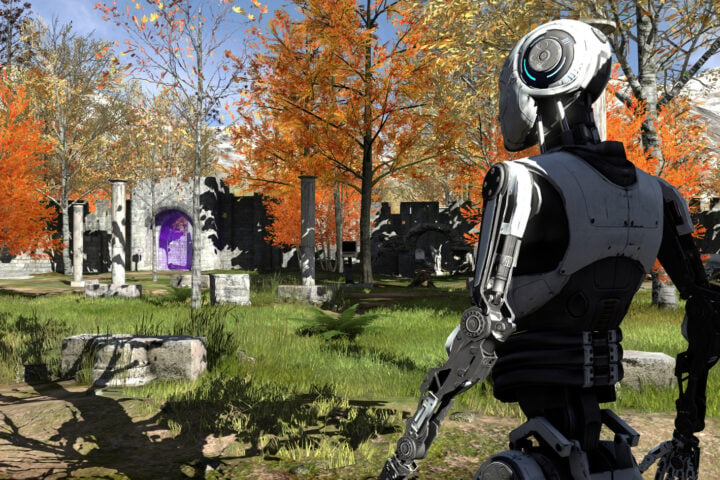
Croteam’s The Talos Principle 2, like its revolutionary predecessor, does a very fine job of using both puzzles and philosophical narrative to turn the world on its head, and sometimes literally so. Everything about the game aims to expand on the original. Where the first game focused on a single person grappling (via puzzles and text) with what it meant to be human, this generations-later sequel surrounds you with the robotic-bodied but human-programmed citizens of New Jerusalem and asks what it means to be part of a society.
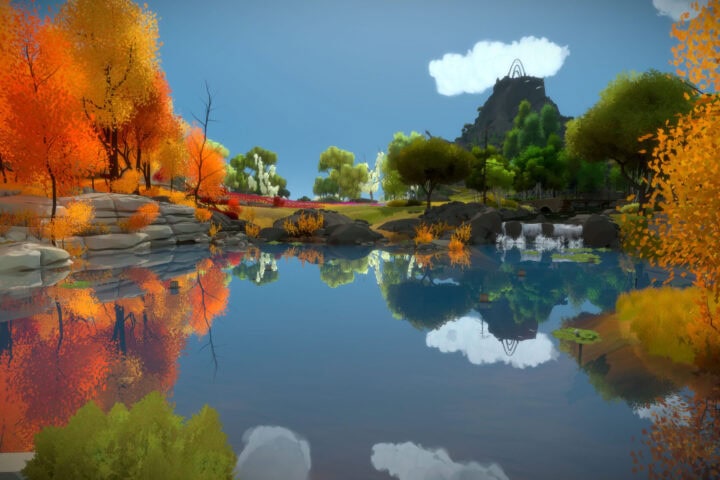
In The Talos Principle 2, there are 12 main areas to explore, each a distinct, vividly rendered biome, among them a canyon pocketed with dazzling pools of water and a hilly crossing atop the back of titanic statues. And instead of facing a single antagonist (the original’s biblically inspired ELOHIM), players face futuristic versions of the mythological Pandora, Prometheus, and the Sphinx, each of whom prompts you to choose whether your kind should inherit their “Theory of Everything” power as you explore a vast megastructure of unknown origins.
This time around, there’s also more voice-acted conversation (as opposed to just texts). You’re 1K, the thousandth citizen of New Jerusalem and ostensibly the final one to be created, and your status is the center of many of the conversations that you have with your fellow androids. Some of their dialogues may be a tad basic for philosophy majors, but they’re delightfully written so as to give each companion a distinct personality and purpose, and ultimately succeed in being as much of the game’s point as the puzzles. Talking about your discoveries changes your progress from something that you merely earn to something that you more deeply engage with.
That said, the puzzles are where The Talos Principle 2 thrives, and where it most eclipses its predecessor. Almost every tool from the original game makes a return in the prologue, and the game spends the next 20 or so hours introducing devices that are new not only to this series, but to first-person puzzlers in general. The very first of the game’s 12 biomes, the Grasslands Ring, introduces RGB Converters, instantly expanding upon the original’s use of blue and red lasers with a new third output. Along the way, players will pick up Drillers that poke holes in specific surfaces, Accumulators that carry a charge, and Activators that, if triggered, directly power anything in their circumference. These are delightful, rule-breaking contraptions, each of which allows players to make the most of their circumstances if only they can figure out how.

The game cites concepts like G. K. Chesterson’s “prison of thought,” the notion that a person can be stuck in a single idea, and uses its best levels to showcase philosophy in action via a steady stream of devices ensuring that players do not become beholden to any one solution. Asked to “be open to answers which challenge your assumption,” we can demonstrate such rule-breaking by sending a Driller through its own hole, or carrying a clone of yourself to a goal. The game’s brilliant final act simultaneously occurs across two possible futures, a dystopia and utopia, suggesting that only by embracing the potential of failure can humanity grow.
The game is also more accommodating of players than its predecessor, as it really wants you to see the campaign through to the end. As in the first game, each new area highlights a specific tool, the levels within it slowly building in complexity, but now players can use the tokens they earn during puzzle-solving to outright backdoor, or skip, anything too challenging. This agency ties directly into the narrative’s purpose, in that you can reach one set of endings with a passable understanding of these individual tools, but in order to get the best outcome, you’ll need to work with all the resources at your disposal in the brain-bending optional end-game puzzles.
The aha-moment click of solving a puzzle is consistently satisfying, and on that level alone, The Talos Principle 2 delivers in spades. But where it soars is in the way that the discrete parts introduced throughout the game slowly begin to come together, revealing something akin to one massive, interlocking bit of machinery. If you buy into the game’s conceit, that humans are themselves machines, then these aha moments are more than just the thrill of accomplishment and more like a celebration of our inquisitive humanity and capacity for growth.
This game was reviewed with code purchased by the reviewer.
Since 2001, we've brought you uncompromising, candid takes on the world of film, music, television, video games, theater, and more. Independently owned and operated publications like Slant have been hit hard in recent years, but we’re committed to keeping our content free and accessible—meaning no paywalls or fees.
If you like what we do, please consider subscribing to our Patreon or making a donation.