In Susan Lacy’s 2017 documentary Spielberg, Peter Coyote succinctly identifies the mystique of E.T.: The Extraterrestrial: “There are no two humans on Earth that are farther apart than those humans and that alien creature…If [they] could all love and empathize and make a rapprochement…with this creature, so, too, can any two humans on Earth.” It’s a thesis that applies to Steven Spielberg’s lifelong fascination with aliens in general, a recurring motif in the canon of an all-American icon that’s balanced cutting-edge technical wizardry with increasingly weighty and personal examinations of empathy and otherness across borders of all kinds.
In E.T. and Close Encounters of the Third Kind, the coming of benevolent alien others is juxtaposed with Cold War paranoia and cataclysmic, intimately painful fractures in the American nuclear family, both reflecting the joys and terrors of Spielberg’s family life, which he eventually dramatized directly in The Fabelmans. In lieu of his once-estranged father’s Orthodox Judaism, so the psychoanalytic reading goes, Spielberg pledged his faith in messianic aliens, which he sees as having the potential to heal broken families, broken nations, and a broken world—making, with the incalculable musical support of John Williams, for science-fiction cinema of an uncommonly piercing emotional and spiritual heft.
Spielberg’s outlook on extraterrestrials hasn’t changed since the 1970s, except he no longer sees them as a metaphor—so the 79-year-old director informs us in Disclosure Day’s final trailer. He’s certain that extraterrestrials are real, that the American deep state is hiding and possibly abusing them, and that announcing their existence on the evening news (remember the evening news?) wouldn’t be just another surreal item in the spiraling 2020s media cycle, but a singular event that would instantly unite and transform human consciousness as we know it.
Lest we doubt this, Disclosure Day’s characters state it repeatedly. Perhaps reflecting his newfound confidence in a forthcoming alien rapture as factual certainty, or perhaps having finally exorcised his personal demons in The Fabelmans, what stands out about Spielberg’s uneven, dramatically stillborn new film is the lack of a fractured family core weighing his conspiracies and aliens down to earth. Delivered from the heights of personal and professional validation, the great prophet of Hollywood’s latest is akin to a detached, rambling, and sermonistic exercise that treats cinema and humanity as a great and curious jigsaw puzzle.
Disclosure Day’s marketing has emphasized utmost secrecy, teasing only disparate images and cast members while asking prospective viewers to place their faith in the Spielberg name. This isn’t just a clever promotional conceit, as the entire film, scripted by David Koepp and based on an original story by Spielberg, is structured around the concealment of information. Beginning in medias res with a chase sequence in progress, Disclosure Day greets us with decontextualized imagery and archetypes clipped and remixed from past Spielberg films before drip-feeding us the hows and whys, which it does with seemingly endless exposition.
The film’s characters are introduced as capital-T types. Daniel Kellner (Josh O’Connor) is a doe-eyed rebel idealist of the kind one associates with, well, Josh O’Connor, a Snowden-esque government contractor who’s stolen a trove of data and a crystal-shaped alien Macguffin from his former employers, with the intent of exposing the great alien revelation to the world. Hugo Wakefield, played by Colman Domingo, is Daniel’s handler, a buttery-voiced authority figure with a mysterious warmth that one associates with…Colman Domingo.
Elsewhere, Jane Blakenship (Eve Hewson) is Daniel’s ride-along girlfriend, whose struggle with faith and doubt regarding her partner and lapsed Catholicism in the face of alien gnosis (she’s a former nun) elicits Dana Scully flashbacks. And Noah Scanlon (Colin Firth) is Daniel’s pursuer, who we know is bad news because he’s the black-van-riding head of a private defense contractor neck-deep in the alien conspiracy business and, more importantly, because he speaks slowly and Britishly and wears one of two expressions at all times: a devil’s smirk and a sweaty scowl. Scanlon wants to keep the extraterrestrial truth under lock and key because he doesn’t believe humanity is ready—and wants to monopolize alien tech for himself—while Daniel wants to get it to the media, because “the truth belongs to eight billion people.”
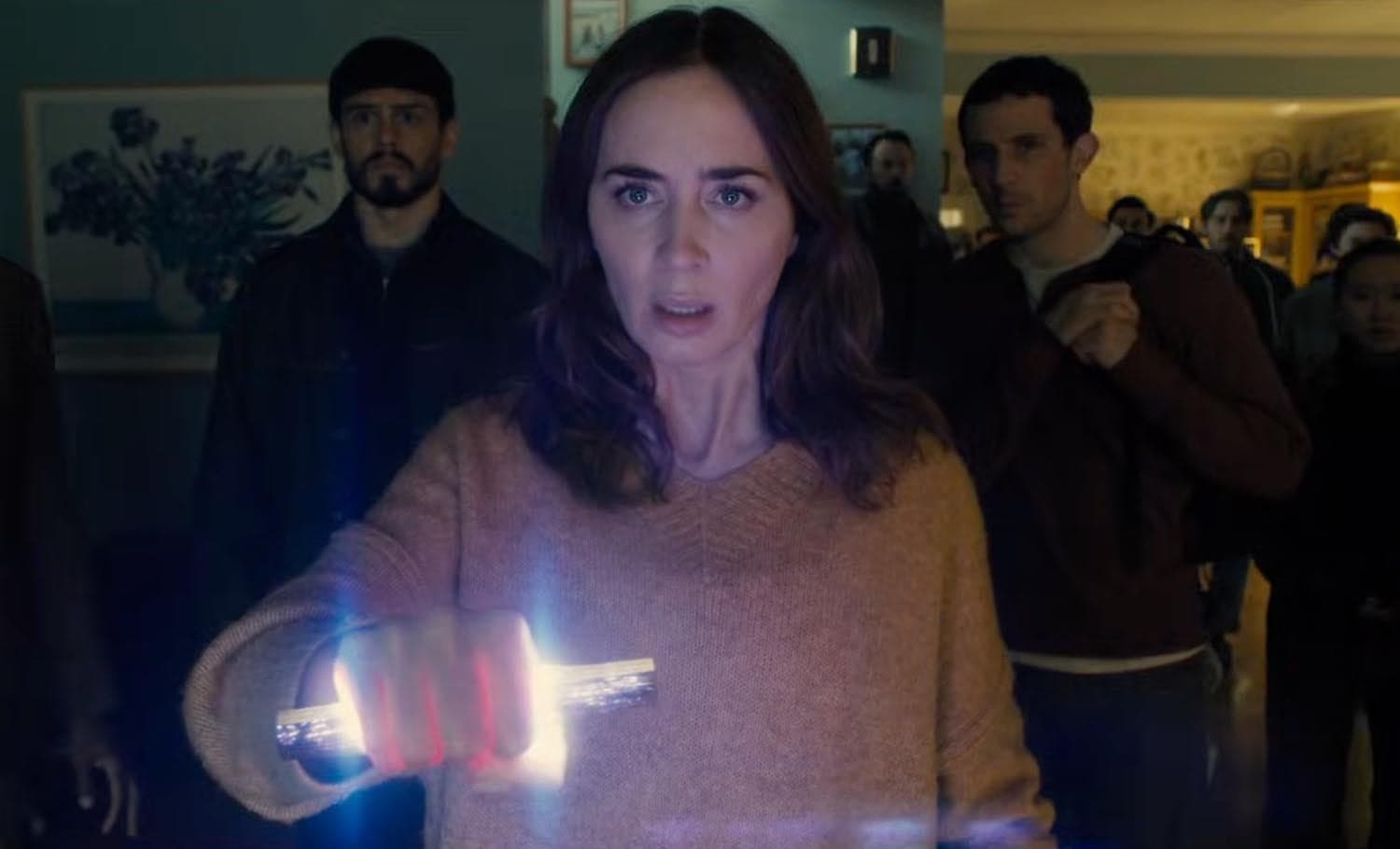
The other major plotline, which initially appears unconnected to the chase for the crystal—and the connection is never totally convincing even after the threads intersect—follows Margaret Fairchild (Emily Blunt), a ditzy Kansas City weather reporter with a layabout bohemian boyfriend (Wyatt Russell). One day, Margaret begins exhibiting strange behavior after staring into the eyes of a bird. As developing news of a potential World War III-level confrontation buzzes anxiously at her local news station, Margaret suddenly begins speaking in tongues and foreign languages, blurting out sensitive information about people and politics she couldn’t possibly know, and eventually collapses on air. Inexplicable impulses take hold of her and commandeer her actions, setting her on a collision course with the fugitive Daniel.
The essential mechanism of human-alien communion in Disclosure Day reads suspiciously close to the powers of a movie director—or a godlike A.I.—and it’s one that the film’s villainous military-industrial complex wishes to usurp. Unseen forces have the power to take conspicuously C.G.I. animal forms and possess human bodies like puppets, giving them omniscient knowledge of the world and absolute empathy with other human minds, making them say and do the exact right things at the right times and places to advance a grand narrative design that’s only gradually revealed to the spectator.
A late set piece even involves the construction of a film set recreating a character’s childhood home, for the express purpose of having that character reenact a suppressed memory. It’s undeniable that the film’s concepts have personal significance for Spielberg, suggesting the medium to which he’s dedicated his life as a mystical adjudicator of knowledge and empathy with the power to bring a collapsing global order back from the brink.
The problem is that the drama supporting all of Disclosure Day’s ideas is convoluted and schematic, and at its worst is out of touch. Parts of a jigsaw puzzle that they are, the characters are eventually “solved,” except it’s through blunt expository dialogue announcing their motivations, backstories, and development as the plot keeps on twisting bewilderingly through a memory lane of Spielbergian imagery: a white-knuckle car chase here, a lens-flare-drowned industrial futurist space there, a dusky suburban home on the horizon.
This reductive approach to psychology is even acted out on screen, with the possessed Margaret able to instantly disarm interlopers and gain access to restricted spaces by delivering one-sentence therapeutic bromides that ostensibly resolve the defining traumas of a person’s life. She’s like a TV spirit medium on steroids. Conflicts between characters serve to analogize the risks of disclosing sensitive information in a relationship to the risks of disclosing sensitive information to the public, but these moments are discursive to the point of leaving the film feeling disjointed. Characters strictly respond to new revelations in ways that move the plot along, regardless of whether those responses make much sense.
After an escalatingly choppy and credulity-straining final act, the eventual endpoint of the whole rollercoaster feels like a copout. In this precarious moment for the arts and the world, do you believe that aliens, cinema, or both can save us from ourselves? There’s no doubt that Spielberg does, but clutching to the memories of bygone moments and media, he’s never seemed less certain as to how. Disclosure Day is an odd, self-reflexive stew of an aging master’s memories and fixations, so jumbled and meta that it’s grown detached from its own form as narrative art.
Since 2001, we've brought you uncompromising, candid takes on the world of film, music, television, video games, theater, and more. Independently owned and operated publications like Slant have been hit hard in recent years, but we’re committed to keeping our content free and accessible—meaning no paywalls or fees.
If you like what we do, please consider subscribing to our Patreon or making a donation.