
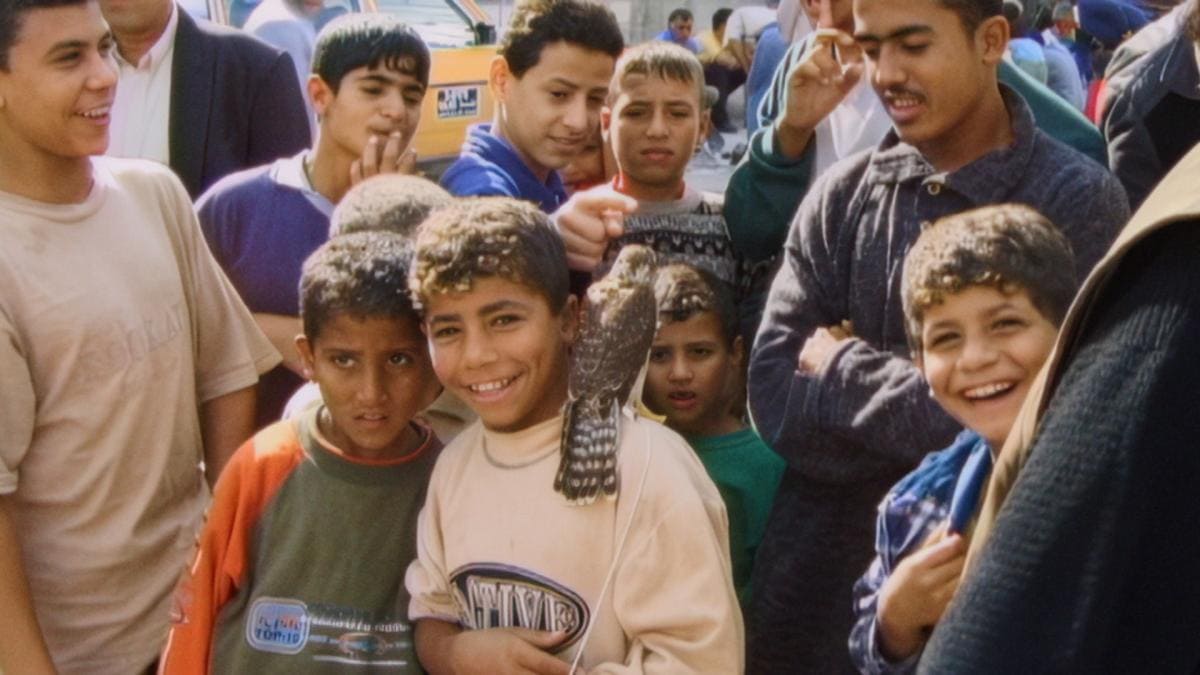
Kamal Aljafari, a specialist in archival documentaries, describes the creation of With Hasan in Gaza as the accidental discovery of a time capsule. This travelogue’s footage was recorded on miniDV tapes during a visit by the filmmaker to the Gaza Strip in 2001, only to sit unused for nearly 25 years before being digitized and edited into a feature.
The result is both a document of a precise historical moment and testament to the continuity of Palestinian memory and struggle. Imprisoned by Israel at age 17, during the First Intifada, for alleged involvement in a militant group, Aljafari traveled to Gaza from Germany at age 28 to try and track down a fellow inmate whose fate was unknown to him. To do so, he enlisted the services of Hasan Alboubou, a local guide whose fate is unknown to him now. This was during the early days of the Second Intifada, shortly after the collapse of the peace process, over three decades since Israel’s occupation of Gaza, several years before Israeli withdrawal and the seizure of absolute power by Hamas, and over two decades before the currently ongoing war would raze much of the strip to rubble, killing as many as one in every twenty Palestinians living there.
With Hasan in Gaza is politically striking, then, for its familiarity. In a world before smartphone photography and a Palestine where Hamas is relegated to the shadows, the stories and visuals of Israeli occupation and assault are consistent with the extreme images that have shocked the world today. The Star of David is carved into mangled buildings as a symbol of dominance. Checkpoints and militarized settlements are glimpsed from a distance, metallic structures cutting through the sunkissed desert land, strategically placed to restrict Palestinian movement.
The guns, tanks, and hostile voices of the barely glimpsed Israeli “other” cut through the air in the hot, still day and through skirmishes with invisible militants at night (the two sides are distinguished by the pitch of their weapons fire). Their menacing omnipresence, always just off screen, inspires fear and defiance in equal measure among the occupied people.
And it’s those people, beside the land, whom the young Aljafari is eager to engage with the camera as active participants in their own story, capturing a rugged beauty and a persistence of life behind the frontlines of occupation and ethnoreligious war. Touring Gaza’s streets and buildings, Aljafari and Hasan come across an array of citizens making the most of their circumstances. Men and boys sell fresh fish for shekels in a seaside market. A young farmer tends gently to his horse and goats. Middle-aged men, unable to find employment in an economy reliant on Israeli work permits, laugh while playing cards in a saloon.

Subjects react differently to the then-novel camera’s presence. Children at play, seemingly oblivious to the strife around them, are delighted by the chance to be filmed; they demand it, and briefly glory in wielding the camcorder for themselves. Wives in hijabs invite Aljafari’s camera in a different way: to capture the damage to residential buildings by the mortar shells that have displaced their families. (In a striking image, the wives have recovered the shells and shrapnel that struck their houses, presenting them to the camera with the hope of exposing the Israeli army’s ruthlessness.) A younger man in a crimson-yellow jumpsuit, wandering alone through the rubble of a destroyed house near settlement borders, pleads not to be filmed as he fears losing his Israeli work visa, and Hasan reassures him that “no Israeli will see this.”
The active role of the camera here calls to mind the many cameras wielded by the people of Gaza to tell their own stories in the Rashid Masharawi-curated From Ground Zero, a more vibrant, populist, and contemporary account of Palestinian suffering and endurance in Gaza. Aljafari’s loose assemblage takes on a ghostlier tone, the washed-out colors and blurry textures of his restored minicassette footage creating a myopic, shimmering lost present preserved in digital amber. Meandering footage that might otherwise be mundane attains spectral power from the non-presence of things Aljafari’s camera doesn’t or can’t show: the direct violence and death of the conflict, the land of Israel-Palestine beyond Gaza, the weight of past decades of struggle and displacement, the unknown or grimly known fates of the people and places depicted.
Connecting the film to that larger flow of history are two forms of present-day editorial intervention, and both are used sparingly. The first is the score, a series of haunting electronic wails composed by frequent Derek Jarman collaborator Simon-Fisher Turner, combined with mournful Arabic ballads expressing Palestinian nationalist sentiment: the desire to “go back in time,” reunite with lost comrades, reclaim lost land. The second is a series of intertitles written in Aljafari’s voice, recalling both fond memories of his family and bitter memories of his and his family’s abuse and displacement by the Israeli state, which the onetime prisoner accuses of making all of Gaza and Palestinian life “a prison.”
Like the documentary itself, these intertitles focus on presenting an archive of people and events that can feel prosaic and placid on the surface, yet the sorrow and rage beneath that surface is nearly beyond expression. With Hasan in Gaza’s sights and sounds from the occupied road aren’t always riveting viewing moment to moment, but they leave a crushing emptiness in their wake. Beyond personal memento, the film’s value as a memory record of a people under siege is greater than its interest in aesthetic excitement.
Since 2001, we've brought you uncompromising, candid takes on the world of film, music, television, video games, theater, and more. Independently owned and operated publications like Slant have been hit hard in recent years, but we’re committed to keeping our content free and accessible—meaning no paywalls or fees.
If you like what we do, please consider subscribing to our Patreon or making a donation.


A vital film for the entire world to see, portraying the history of Israel’s horrific crimes against the Palestinian people. “…the sorrow and rage beneath that surface is nearly beyond expression…” yet Western governments and the almost entirely pro-Israel Western corporate media profess astonishment when Palestinians rise up against Israel’s oppression.